




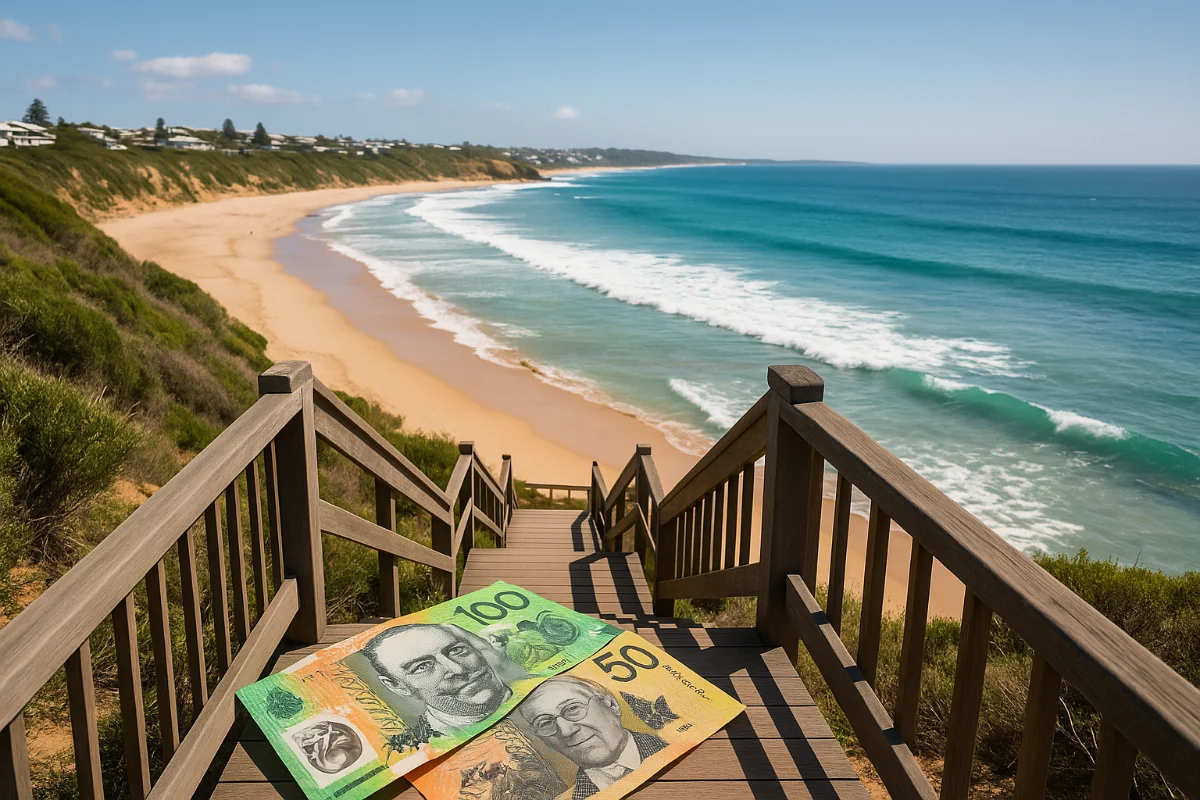
Financial Freedom Australia: A Complete 2025 Guide to Building Wealth
- October 08, 2025
- by
- thetradieguide@gmail.com
1. Why Financial Freedom Australia Matters More Now
Let me paint you a scene:
You wake up one morning, check your phone, and your bank account hasn’t drained overnight (hallelujah). You look out the window, see that the mortgage or rent is covered, your investments are humming softly, and—this is the dream—money isn’t the main source of your stress.
That, dear reader, is financial freedom. In this post, we’ll walk through how Australians in 2025 can build toward financial freedom, step by step. We’ll cover mindset, strategy, systems, real Australian dynamics, pitfalls, and some laughs along the way.
You won’t get fluff. You’ll get a clear roadmap. Let’s go.
2. At a Glance (Quick Overview / Snapshot Summary)
- What is financial freedom? Being able to cover your expenses indefinitely from passive or investment income, without relying solely on active work.
- Why Australia is a unique case: Superannuation rules, tax structure, cost-of-living pressures, property market, etc.
- Core levers to pull: Control expenses, eliminate bad debt, maximise income, invest wisely, protect against risks.
- Milestones: Emergency fund → debt freedom → investing habit → income diversification → sustainable “withdrawal phase.”
- Estimated timeline: Varies widely (5–30 years) depending on income, discipline, compounding, and risk choices.
Want the full roadmap? Keep reading
3. What Does “Financial Freedom Australia” Really Mean?
Before we dive into steps, we must define our goal. Financial freedom is not about being a millionaire (though that helps). It means:
- Your basic needs and desired lifestyle are funded via investments, passive income, or a sustainable “safe withdrawal rate.”
- You have choices: whether to work or not, or how to work.
- You’re resilient to life shocks (job loss, illness) because you have buffers and plans.
- You’re no longer chained to the “paycheck-to-paycheck treadmill.”
In the Australian context, that means dealing with:
- Superannuation rules — compulsory employer contributions (12% as of July 2025) (Wikipedia)
- Tax benefits and brackets
- Housing market constraints
- Cost-of-living pressure (utilities, energy, rentals, etc.)
- Regulatory and economic environment
Australia’s economic system is generally supportive — in the 2025 Index of Economic Freedom, Australia received a score of 79.3, placing it among the world’s freer economies. (Heritage Foundation) But individual financial freedom is still hard without discipline and knowledge.
4. The Big Pillars of Financial Freedom (Australia Edition)
Think of this as your multi-lane roadmap. You want to make progress in all lanes:
| Pillar | What It Means | Australian Nuances |
|---|---|---|
| Mindset & Vision | Clarity on what you truly want | “Freedom” means different things—some want early retirement, others just less stress |
| Income & Career Growth | Increasing your active income | Side hustle, salary negotiation, upskilling |
| Expense Control & Budgeting | Living below means, trimming waste | Utilities, subscriptions, food, discretionary spending |
| Debt Management | Eliminating high-interest debt | Credit cards, consumer loans (not all debt is bad) |
| Investing & Wealth Accumulation | Deploying capital for returns | Shares, ETFs, real estate, superannuation |
| Risk & Protection | Safeguards against life’s curveballs | Insurance, emergency fund, diversification |
| Exit / Withdrawal Strategy | How you sustainably “live off” wealth | Safe withdrawal rates, “FIRE” approaches, hybrid work |
Let’s unpack these one by one, with Aussie flavor.
5. Pillar Deep Dive + Practical Steps
5.1 Mindset & Vision
You can’t drive somewhere if you don’t know where you’re going.
- Define your “Freedom Number” — how much money per year (after tax, adjusted for inflation) do you want to live your ideal lifestyle?
- Time horizon matters — 5 years, 10 years, 20 years — your plan changes accordingly.
- Embrace a “growth mindset” about money — if you think, “I’m terrible at money,” expect to stay stuck.
Pro Tip Box:
Most people overestimate what they can do in one year, but underestimate what they can do in 5–10 years. Start small, aim consistent.
5.2 Income & Career Growth
To free up the “freedom bandwidth,” you often need extra cashflow:
- Ask for raises or promotions (do your research, show results)
- Side hustles or freelancing (digital skills, consulting, creative gigs)
- Passive or semi-passive income streams — e.g. small eCommerce, affiliate, rental property
- Upskill in in-demand fields (tech, digital marketing, fintech)
Money is like yeast — you need enough dough for growth, or else you stay flat.
5.3 Expense Control & Budgeting
Even if you make $200k, if you blow $195k, you’re not free. Step 1: track, cut, optimize.
- Use apps or spreadsheets to track every dollar for 30–60 days
- Identify “money leaks” — subscriptions, impulse buys, unused memberships
- Use a “zero-based budget” — every dollar has a job
- Automate savings (round-ups, scheduled transfers)
In 2025, the Australian government encourages small financial resets: “spend smarter, boost your savings, automate your savings” are among recommended tactics. (Moneysmart)
5.4 Debt Management (Bad Debt vs Strategic Debt)
Not all debt is evil — your housing loan (in many cases) is a tool. But credit cards and consumer debt? Nope.
- Target highest interest debt first (credit cards, personal loans)
- Use snowball or avalanche method
- Refinance or renegotiate if possible
- Avoid acquiring new bad debt
Fun fact: in 2025, 46% of Australians began the year in debt. That’s nearly half the country. (salvationarmy.org.au)
5.5 Investing & Wealth Accumulation
This is where the magic happens: your money working so you don’t have to.
- Superannuation: Maximise its growth. It’s tax-advantaged, and compulsory for almost everyone. (Wikipedia)
- Index funds / ETFs / shares – low-cost, diversified
- Real Estate — cautious, but property is often part of Australian portfolios
- Bonds, fixed income, alternative assets — for balance
- Dollar-cost averaging (spread your investments over time, reduce timing risk)
- Compound interest — time is your secret weapon
Did You Know?
If you invest $500/month in an ETF that returns 7% annually, in 20 years you’ll have ~A$250k (ignoring taxes). It’s the “slow drip with compounding” trick.
5.6 Risk & Protection
Freedom means you survive the surprises.
- Emergency fund: 3–6 months of living expenses, in a safe, liquid account
- Insurance: health, life, income protection — don’t skip this
- Diversification: don’t put all eggs in one basket (one stock, one property)
- Legal structures: wills, trusts, estate planning
Because yes — life can throw curveballs (job loss, medical emergencies). Without buffers, good plans die fast.
5.7 Exit / Withdrawal Strategy & Sustainable Living
Once your investments can cover your lifestyle, how do you live off your capital (without inevitably running out)?
- Use a safe withdrawal rate (often ~3–4–5%, depending on risk)
- Hybrid models: part passive income, part light work, part project-based
- Gradual transition: test the waters by reducing work hours
- Monitor your portfolio over time and adjust
Some Aussies adopt the FIRE (Financial Independence, Retire Early) approach — though it’s not for everyone. (The Gild Group)
6. Quick Guide: From “Paycheck to Freedom” (Example Path)
Intro:
Your friend Sarah earns $80,000/year, has $20,000 debt, and wonders how to get from paycheck-to-paycheck to financial freedom Australia.
Common Challenges:
- Can’t break the overspending habit
- Fear of investing / “I’ll lose money”
- Feeling overwhelmed by taxes, superannuation, and finance jargon
How to Solve It:
- Build a starter emergency fund (~$5,000)
- Aggressively pay down high-interest debt (credit card, personal loans)
- Start a basic investment plan: Even $100/month into a low-cost ETF
- Track and reduce expenses — e.g., cancel unused subs, cook more, renegotiate utilities
Why It Works:
These steps reduce your financial vulnerability, generate small “wins,” and build momentum. Compound returns then accelerate growth.
If you feel stuck or need help mapping your own path, shoot me a message—happy to help you design your own plan.
7. Interactive Section: Financial Freedom Australia Quiz
How far along are you on the path to Financial Freedom Australia? Rate yourself (1–5) on each, then score below.
| Question | Rate Yourself (1 = Not at all / 5 = Fully) |
|---|---|
| I have a written vision or “freedom number” | 1 2 3 4 5 |
| I track all my income & expenses monthly | 1 2 3 4 5 |
| I have no high-interest debt (e.g., credit cards) | 1 2 3 4 5 |
| I regularly invest (monthly or recurring) | 1 2 3 4 5 |
| My emergency fund can cover 3 months of expenses | 1 2 3 4 5 |
| I understand my superannuation and optimise it | 1 2 3 4 5 |
| I have protected myself with insurance / legal structures | 1 2 3 4 5 |
| I could reduce my hours of work if needed | 1 2 3 4 5 |
Scoring Guide:
- 8–24: Early days — you’re at “foundation building” stage
- 25–32: On your way — you’ve got pieces in motion
- 33–40: Advanced — close to or at financial freedom territory
Based on your score, pick one pillar (from above) and focus on it this month. Don’t try to juggle all seven at once!
8. Challenges & Pitfalls to Watch For (Aussie Edition)
- Lifestyle creep – as income rises, expenses creep too
- Bad advice / scams — be wary in Australia of unlicensed financial operators
- Overleveraging in real estate — property can help or hurt, depending on markets
- Tax surprises — changing rules, capital gains, negative gearing risks
- Market crashes / volatility — stay diversified and keep perspective
- Inflation & cost-of-living — must keep updating your “freedom number” over time
In 2025, for example, many Australians continue to feel stretched — nearly one in three reported difficulty meeting obligations. (CEDA)
9. The Australian Context: Data & Trends We Should Know
- Debt prevalence: 46% of Australians started 2025 in debt. (salvationarmy.org.au)
- Superannuation size: Australians collectively hold over AUD 4 trillion in super funds. (Wikipedia)
- Retirement confidence rising: In 2025, 33% of Australians surveyed felt confident they’d retire when planned (vs 24% in 2023). (SSGA)
- Household resilience: In its 2025 Financial Stability Review, the RBA noted that household financial stress has somewhat stabilised, though pressures remain. (Reserve Bank of Australia)
These trends tell us: there’s demand, challenge, and opportunity in Australia in 2025 for those aiming at Financial Freedom Australia.
10. FAQs (Frequently Asked Questions)
Q: How much money do I need to achieve financial freedom in Australia?
It depends on your lifestyle, region (Sydney vs regional area), inflation assumptions, and safe withdrawal rate. A rough rule: if you need AUD 50,000/year after tax, and you assume a 4% withdrawal rate, your target “nest egg” is ~AUD 1.25 million.
Q: Can I retire early (before pension age) in Australia?
Yes — but you’ll need your investments to support you till you reach eligibility for government pensions or benefits. Many people adopt hybrid models (some part-time work). This is the FIRE concept. (The Gild Group)
Q: Should I put extra money into my super or into a brokerage account?
It depends on your tax bracket, investment horizon, liquidity needs, and the comparative returns. Super has tax advantages, but is less accessible until retirement. Diversifying across both is often wise.
Q: What’s a “safe withdrawal rate” in the Australian market?
Globally, many use ~3–4%. In Australia, given local risk, currency, and market volatility, some use 3–4% or slightly lower. If your portfolio is AUD-denominated, your longevity estimates matter.
Q: What if I mess up — lose money, make bad calls?
You won’t die. Reassess, learn, pivot. The more you gain experience, the better your decisions. Avoid paralysis by perfectionism.
11. Conclusion
Financial freedom is not a fairy tale — it’s a disciplined, multi-year journey of mindset, planning, and compounding behaviour. In Australia, the rules (superannuation, tax, property) add flavour and complexity — but the fundamentals remain the same: live below your means, eliminate harmful debt, invest regularly, protect yourself, and plan for sustainable withdrawal. Take steps this week — picture your financial freedom, run the quiz above, pick a pillar to focus on. As the compounding kicks in, you’ll look back in 2–5 years thinking, “Wow, I’m not just surviving — I’m free.”
Disclaimer: I am not a licensed financial advisor. This post is for educational purposes only. Always seek professional advice before making major financial decisions.
You may also Like

How to Choose the Right Loan or Mortgage in Australia (2026 Guide)