





Dispute Resolution in Australia: A Practical Guide for Businesses
- November 24, 2026
- by
- thetradieguide@gmail.com
A supplier fails to deliver essential stock, a customer refuses to pay an invoice, or two business partners disagree about the direction of their company. What begins as a relatively straightforward disagreement can quickly affect cash flow, productivity and business relationships.
Taking legal action is one possible response, but it is not always the most commercially sensible option. Understanding the available dispute resolution methods can help business owners protect their interests while avoiding unnecessary expense and disruption.
Quick Overview
Dispute resolution is the process of addressing disagreements through negotiation, mediation, conciliation, arbitration or court proceedings. The most suitable approach depends on the nature of the dispute, contractual obligations, financial risks and the outcome each party wants to achieve. Australian businesses can also access government-supported dispute assistance and professional legal services.
Understanding where a business dispute begins
Consider a hypothetical Australian wholesale business that has supplied $30,000 worth of products to a retailer.
The retailer claims that some products do not meet the agreed specifications and refuses to pay the outstanding invoice. The wholesaler maintains that the products meet the contractual requirements.
Both businesses face different pressures.
The wholesaler:
- Needs payment to maintain cash flow.
- Believes it has fulfilled its contractual obligations.
- Wants to avoid expensive legal proceedings.
The retailer:
- Is concerned about product quality.
- Wants replacement products or financial compensation.
- Believes withholding payment is justified.
Neither business necessarily benefits from an extended dispute. However, reaching an acceptable resolution requires an understanding of the facts, contractual rights and available options.
This scenario illustrates why dispute resolution involves commercial decision-making as well as legal considerations.
What types of commercial disputes affect Australian businesses?
Commercial disputes can arise throughout the life of a business, regardless of its size or industry.
| Type of dispute | Common causes |
|---|---|
| Contract disputes | Unfulfilled obligations, delays or disagreements about contract terms |
| Debt recovery | Unpaid invoices and overdue commercial payments |
| Partnership disputes | Financial responsibilities, ownership and management decisions |
| Shareholder disputes | Company control, voting rights and business valuation |
| Commercial leasing disputes | Rent, repairs, lease obligations and termination |
| Supplier disputes | Product quality, delivery delays and supply interruptions |
| Intellectual property disputes | Unauthorised use of trademarks, designs or protected materials |
Certain disputes are subject to specialised legal procedures or industry-specific requirements. Identifying the nature of the disagreement helps determine which resolution pathway is appropriate.
Before escalating: establish your legal and commercial position
A business should understand three things before deciding how to proceed.
What can you establish?
Gather the original contract, purchase orders, invoices, emails, delivery records and relevant correspondence.
Create a chronological record of events, separating confirmed facts from assumptions. This can help identify inconsistencies and clarify the issues requiring resolution.
What does the agreement require?
Review the relevant contractual provisions, particularly those dealing with payment, performance, dispute notification, termination and dispute resolution.
Some agreements require parties to attempt negotiation or mediation before commencing certain legal proceedings.
What outcome would benefit your business?
Recovering the entire outstanding amount may be your preferred outcome, but other solutions could also have commercial value.
These might include a payment arrangement, replacement goods, revised delivery commitments or a mutually agreed termination of the contract.
The objective should reflect your legal rights, financial position and future business priorities.
Five dispute resolution pathways in Australia
Australian businesses have several options for addressing commercial disagreements. These approaches differ in formality, cost and who controls the final outcome.
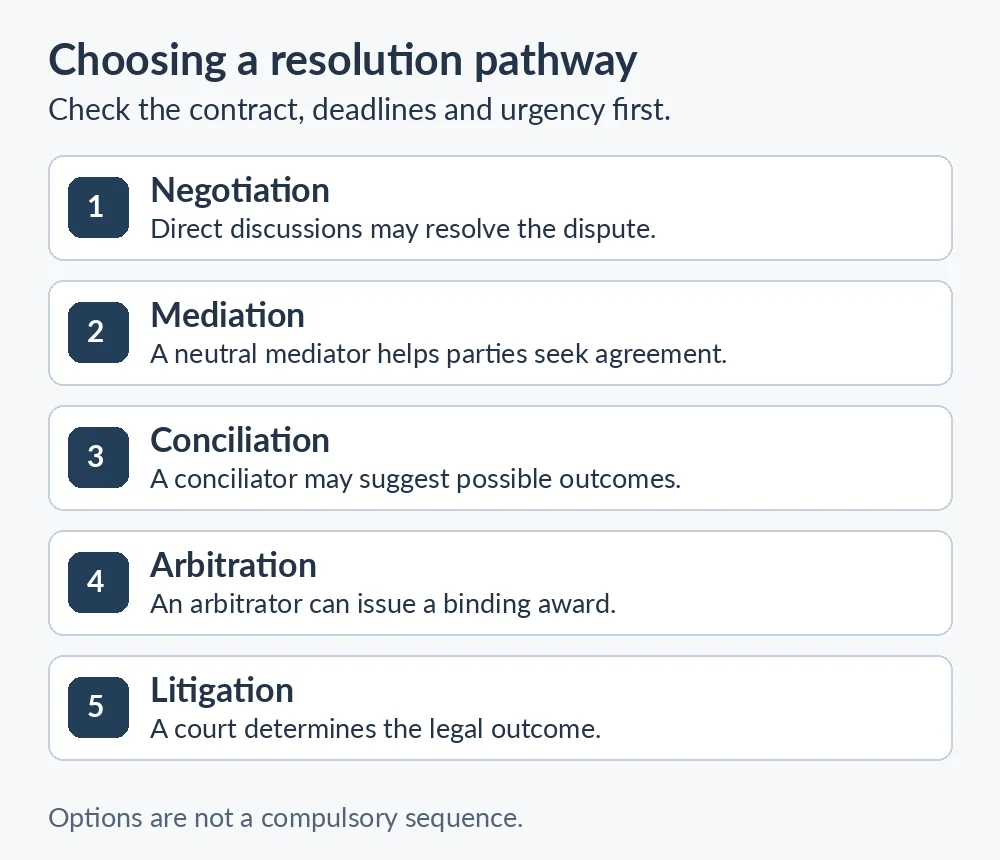
01 — Negotiation
Negotiation involves direct communication between the parties, either independently or through their representatives.
It can be particularly effective when the disagreement involves a misunderstanding, a manageable financial issue or an ongoing business relationship.
Negotiation gives both parties an opportunity to explore practical solutions without immediately involving an independent decision-maker.
02 — Mediation
Mediation involves an impartial mediator who helps the parties discuss their concerns and explore potential agreements.
The mediator does not impose a decision. Instead, the parties retain control over whether they accept a settlement.
Mediation can be useful when direct discussions have reached a deadlock but both businesses remain open to compromise.
03 — Conciliation
Conciliation is similar to mediation, although the conciliator may take a more active role in discussing possible outcomes and providing guidance.
It is available through certain dispute resolution schemes, regulatory bodies and industry-specific processes.
The precise role of the conciliator depends on the applicable scheme.
04 — Arbitration
Arbitration is a more formal process in which an independent arbitrator considers evidence and submissions before making a determination.
Commercial arbitration generally produces a binding award, subject to applicable legal rules.
It may be appropriate when a dispute requires a formal decision and the parties have agreed to arbitration.
05 — Litigation
Litigation involves commencing legal proceedings through the court system.
It may be necessary when alternative approaches are unsuccessful, urgent legal protection is required or an enforceable judicial determination is needed.
However, litigation can involve significant costs, procedural requirements and demands on business resources.
The Australian Government provides further guidance on preventing, managing and resolving business disputes.
Comparing your dispute resolution options
| Method | Who controls the outcome? | Formality | Binding outcome |
|---|---|---|---|
| Negotiation | Both parties | Low | If an enforceable agreement is reached |
| Mediation | Both parties | Low to moderate | If an enforceable agreement is reached |
| Conciliation | Generally both parties | Varies | Depends on the agreement and applicable scheme |
| Arbitration | Arbitrator | Moderate to high | Generally yes |
| Litigation | Court | High | Yes, subject to applicable appeal rights |
There is no universal dispute resolution method that suits every commercial disagreement. A relatively simple payment dispute may be resolved through negotiation, while a complex shareholder dispute may require substantial legal intervention.
When should a business involve a dispute resolution lawyer?
Legal assistance does not necessarily mean taking another business to court.
A lawyer can help assess contractual obligations, examine evidence, identify potential liabilities and develop an appropriate response before the disagreement escalates.
Professional advice becomes particularly important when substantial money is involved, negotiations have failed, contractual obligations are unclear or another party has threatened legal proceedings.
For Victorian businesses facing complex commercial disagreements, professional Dispute Resolution services can assist with contractual disputes, commercial debts, mediation and litigation strategies.
Obtaining advice early can help business owners understand the potential consequences of their decisions, particularly before terminating an agreement or withholding payments.
For a broader understanding of business legal support, see our guide to what commercial lawyers do.
The financial reality of pursuing a dispute
Returning to the hypothetical wholesale business, recovering the outstanding $30,000 may appear to be the obvious objective.
However, the business must also consider the resources required to pursue that amount.
Imagine the following illustrative settlement scenarios.
| Consideration | Negotiated settlement | Litigation scenario |
|---|---|---|
| Amount recovered | $24,000 | $30,000 |
| Assumed unrecovered legal and resolution costs | $2,000 | $12,000 |
| Net recovery | $22,000 | $18,000 |
These figures are hypothetical and do not represent typical Australian legal fees or predicted outcomes. Actual costs, recovery amounts and costs orders vary considerably.
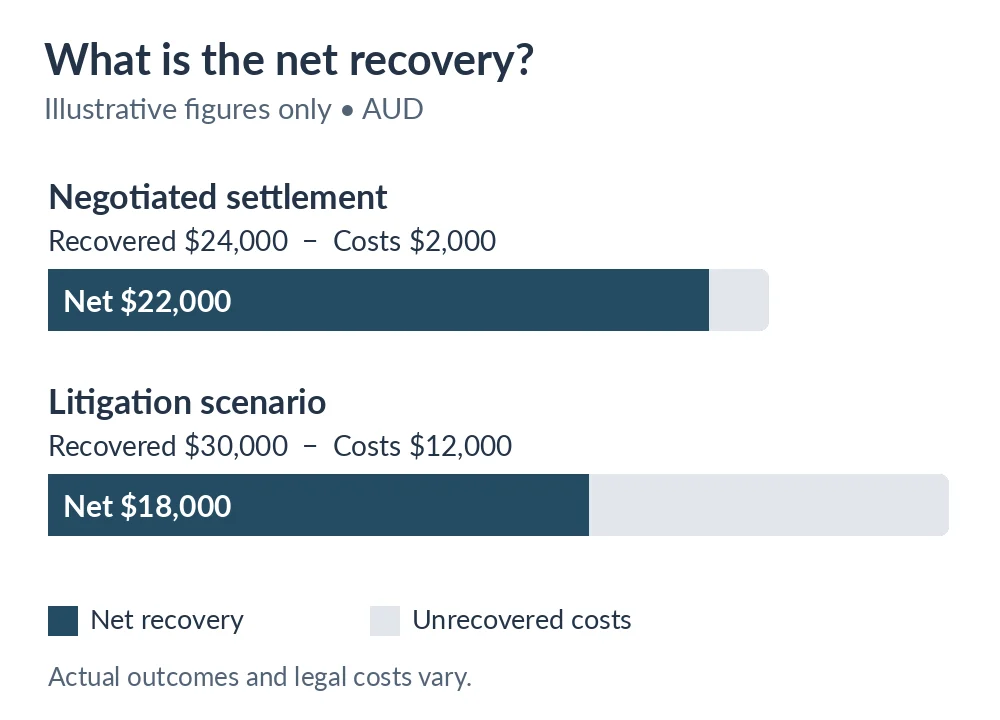
In this example, accepting a lower settlement produces a higher net financial recovery.
The calculation also excludes management time, potential delays, business disruption and the risk that the other party may be unable to pay.
Winning a dispute and achieving a commercially favourable outcome are not always the same thing.
What happens when the parties reach a settlement?
An agreement should clearly establish how the dispute will be brought to an end.
Depending on the circumstances, settlement terms may address the amount payable, payment deadlines, replacement goods, confidentiality, future contractual obligations and the release of claims.
Businesses should also consider what happens if one party fails to comply with the settlement.
For significant or complex disputes, having the settlement professionally documented can help reduce the risk of further disagreements about its interpretation or enforcement.
Government-supported dispute resolution services
Australian small businesses can explore several independent assistance services before committing to formal proceedings.
Australian Small Business and Family Enterprise Ombudsman (ASBFEO)
Provides dispute assistance, information and referrals to suitable services for eligible small businesses and family enterprises.
Website: ASBFEO dispute support.
Victorian Small Business Commission (VSBC)
Assists with eligible commercial disputes involving Victorian small businesses, including certain leasing and business-to-business disagreements.
Website: VSBC dispute resolution guidance.
Australian Competition and Consumer Commission (ACCC)
Provides information about commercial obligations and pathways for addressing business-to-business disagreements, although it does not resolve individual commercial disputes on behalf of businesses.
Website: ACCC business dispute guidance.
Eligibility and available assistance depend on the location, industry and nature of the dispute.
Make future disputes easier to resolve
Businesses cannot prevent every disagreement, but they can improve how disagreements are managed.
A well-prepared commercial agreement should clearly establish responsibilities, payment conditions, performance expectations and procedures for addressing disagreements.
It is also worth reviewing how your business records approvals, manages customer complaints and communicates changes to existing agreements.
A carefully drafted dispute resolution clause can establish who should participate in initial discussions, when mediation may be required and how unresolved matters should proceed.
Businesses should seek advice about suitable contractual provisions and applicable legal deadlines. Negotiations do not necessarily suspend the time limits for commencing legal proceedings.
Final thoughts
Effective dispute resolution starts with understanding what has happened, what your business is entitled to pursue and what a realistic resolution would look like.
Negotiation, mediation, conciliation, arbitration and litigation each serve different purposes. Choosing the appropriate approach requires balancing legal rights with financial risks, operational demands and long-term business objectives.
Addressing disagreements early, maintaining accurate records and obtaining appropriate professional advice can help businesses manage disputes without allowing them to dominate everyday operations.
This article provides general information about commercial dispute resolution in Australia and does not constitute legal advice.
You may also Like

International Estate Planning for Australians: What You Need to Know