





International Estate Planning for Australians: What You Need to Know
- November 22, 2026
- by
- thetradieguide@gmail.com
Owning assets in more than one country can make estate planning considerably more complicated. You might live in Australia, own an investment property overseas, maintain a foreign bank account or have family members living in different countries.
Your Australian will may clearly explain who should inherit your belongings. However, that doesn't necessarily mean every overseas asset can be transferred under the same legal process.
Different countries have their own rules about inheritance, property ownership, taxation and the authority required to administer an estate. Without proper coordination, your executor could face unexpected delays, additional legal expenses or conflicting requirements.
International estate planning is about making sure your arrangements work together across the countries connected to your estate. It involves more than deciding who receives your assets. It also means understanding which laws apply, how those assets are held and what your family may need to do after your death.
Quick Overview
If you have assets or beneficiaries overseas, an Australian will alone may not be enough to ensure straightforward estate administration.
The most important considerations are the location and ownership of your assets, the inheritance laws that may apply, whether you need coordinated wills in different countries, and the possible tax consequences for your estate and beneficiaries.
A well-prepared international estate plan should also make it easier for your executor to identify assets, access essential documents and obtain the appropriate professional assistance.
Start With an International Asset Map
Before deciding whether you need more than one will, identify exactly what you own and where it is located.
Consider someone living in Melbourne who owns a family home in Australia, an apartment in the United States and shares through an overseas investment platform.
Although these assets belong to the same person, they may not all be governed by the same succession and administration requirements.
| Asset | What needs checking? |
|---|---|
| Overseas property | Local inheritance laws, ownership structure and property transfer requirements |
| Foreign bank accounts | Account ownership, beneficiary arrangements and documents required to release funds |
| International investments | Where the assets are legally held, ownership details and applicable tax rules |
| Australian superannuation | Beneficiary nominations, fund rules and whether benefits become part of the estate |
| Business or trust interests | Company documents, trust deeds and succession arrangements |

It's also important to distinguish assets owned personally from those held jointly or through a company or trust.
For example, a property held under a joint tenancy arrangement may pass to the surviving owner rather than through the deceased person's will. Trust assets may be governed by the trust deed instead.
The NSW Government's guidance on wills explains why ownership structures and overseas assets require particular attention.
Creating an accurate asset record gives your advisers a starting point for identifying potential legal conflicts.
Why Different Countries Can Affect the Same Estate
An Australian will is an important legal document, but its effectiveness overseas depends on the circumstances and the laws of the relevant country.
Three issues deserve particular attention.
Recognition of your will
A will that is validly executed in Australia may be recognised in another country. However, recognition is not necessarily automatic, and local formalities or legal procedures may still apply.
The country where an asset is located may have requirements concerning the validity of a will, the documents needed to transfer ownership or the people entitled to inherit.
Some jurisdictions also have mandatory inheritance provisions that can limit how freely certain assets may be distributed.
Different inheritance rules
In Australia, a person's will generally provides instructions for distributing estate assets, subject to applicable laws and possible claims.
Other countries may have rules reserving particular inheritance rights for spouses, children or other family members.
Consequently, a distribution that appears straightforward under Australian law could produce a different legal outcome overseas.
The relevant outcome depends on the particular country, the type of asset and the deceased person's circumstances.
Separate estate administration procedures
Even when an Australian will is recognised overseas, the executor may need additional legal authority to collect or transfer assets.
In Australia, probate is a court process that confirms a will and an executor's authority to administer an estate.
Where assets are held in multiple jurisdictions, separate probate applications or other local procedures may be necessary.
Sometimes an existing court grant can be recognised through a process known as resealing. However, this option is not available for every country or estate.
The Supreme Court of New South Wales explains that an estate involving assets in more than one country may require separate grants, depending on the relevant jurisdictions.
This is one reason international estate planning should consider not only what happens to assets, but how your executor will legally access them.
One Will or Separate Wills for Different Countries?
There is no universal answer.
Some people can manage their affairs through a single carefully drafted will. Others may benefit from separate wills covering assets in different jurisdictions.
The decision depends on factors such as the type and location of property, applicable inheritance laws, probate requirements and professional advice received in each country.
When a single will may be appropriate
A single will may be workable where the relevant foreign jurisdiction recognises it and the administration requirements are manageable.
However, recognition alone does not mean it will be the simplest or most efficient option.
Your lawyer should consider whether the document provides sufficiently clear instructions and whether additional procedures could create unnecessary costs or delays.
When separate wills may help
Separate wills can sometimes make administration easier, particularly when someone owns substantial real estate or other assets in different countries.
For example, one will might address Australian assets while another deals specifically with property held overseas.
However, multiple wills must be carefully coordinated.
A later will may contain a clause revoking earlier wills. If that clause is drafted without considering the other jurisdiction, it could unintentionally invalidate arrangements intended to remain in place.
Each document needs an appropriate scope, and the lawyers preparing them should understand the other documents.
NSW Trustee and Guardian discusses these considerations in its guidance on preparing wills involving overseas assets.
Never assume that independently preparing a will in each country will automatically produce a coordinated estate plan.
Remember That Not Every Asset Passes Through Your Will
International planning can become complicated even before foreign inheritance laws are considered.
Australian superannuation is a useful example.
Your superannuation does not automatically form part of your deceased estate. Depending on the fund's rules and any valid beneficiary nomination, the death benefit may be paid to eligible beneficiaries or to your legal personal representative.
A binding death benefit nomination can provide direction to the trustee when valid, but requirements and expiry arrangements vary.
ASIC's Moneysmart guidance on superannuation death benefits explains how beneficiary nominations operate.
Similar care is needed with foreign retirement accounts, jointly held property, life insurance and trust arrangements, although the governing rules can differ substantially.
An effective estate plan considers these arrangements alongside your will rather than assuming one document controls everything.
International Estate Planning and Tax: What Australians Should Understand
Cross-border inheritance can involve several different types of taxation. The important distinction is that tax rules depend on the asset, the people involved and the countries concerned.
Australia has no inheritance tax
Australia does not impose a general inheritance or estate tax.
Receiving an inheritance does not ordinarily create Australian tax simply because you have inherited money or property.
However, other tax consequences may arise.
For example, capital gains tax may become relevant when an inherited asset is subsequently sold. Income earned by inherited investments or property may also be taxable.
The Australian Taxation Office provides further guidance on taxation of inherited assets.
Overseas inheritance taxes may apply
The absence of Australian inheritance tax doesn't prevent another country from imposing its own estate, inheritance or succession taxes.
The United States, for instance, has federal estate tax rules that can apply to certain US-situated assets owned by people who were neither US citizens nor US residents at death.
The treatment depends on matters including the nature and location of the assets, citizenship, domicile and any relevant treaty provisions.
The US Internal Revenue Service explains the federal estate tax framework for nonresident noncitizens.
Other countries have different rules, and some may impose additional regional or local taxes.
Australian tax residency still matters
Australian residents for tax purposes generally need to declare their foreign and worldwide income, subject to the applicable rules.
This can include rental income from overseas property and income from foreign investments.
Capital gains tax may also apply when a foreign asset is sold.
Depending on the circumstances, foreign tax offsets or treaty provisions may affect the final tax position.
For these reasons, cross-border estate planning may require both legal and specialist taxation advice. It is particularly important to distinguish a person's Australian tax residency from other legal concepts, such as domicile, that may be relevant overseas.
Building an Estate Plan That Works Across Borders
A practical international estate plan usually involves four connected stages.
1. Establish the full picture
Your advisers need to understand your assets, liabilities, family arrangements and international connections.
Relevant details may include citizenship, countries of residence, tax residency, property ownership, overseas bank accounts and the location of intended beneficiaries.
Changes in residency or citizenship can be especially important when considering international tax obligations.
2. Identify which laws and procedures may apply
The next step is to establish which jurisdictions are relevant to each asset.
This includes considering whether your current will can operate effectively overseas, whether local inheritance restrictions apply and what authority your executor may need.
A lawyer familiar with Australian estate law may need to work with a professional qualified in the relevant overseas jurisdiction.
3. Coordinate the legal and financial arrangements
Once the requirements are understood, your advisers can recommend an appropriate structure.
That might involve revising an existing Australian will, coordinating separate wills, reviewing ownership arrangements or updating beneficiary nominations.
For estates involving both Australia and the United States, Bayside Wills and Estates Lawyers provides international estate planning services addressing cross-border assets, beneficiaries and succession considerations.
The objective is to ensure the various arrangements support each other rather than creating conflicting instructions.
4. Prepare for the administration process
A well-drafted will is only part of the preparation.
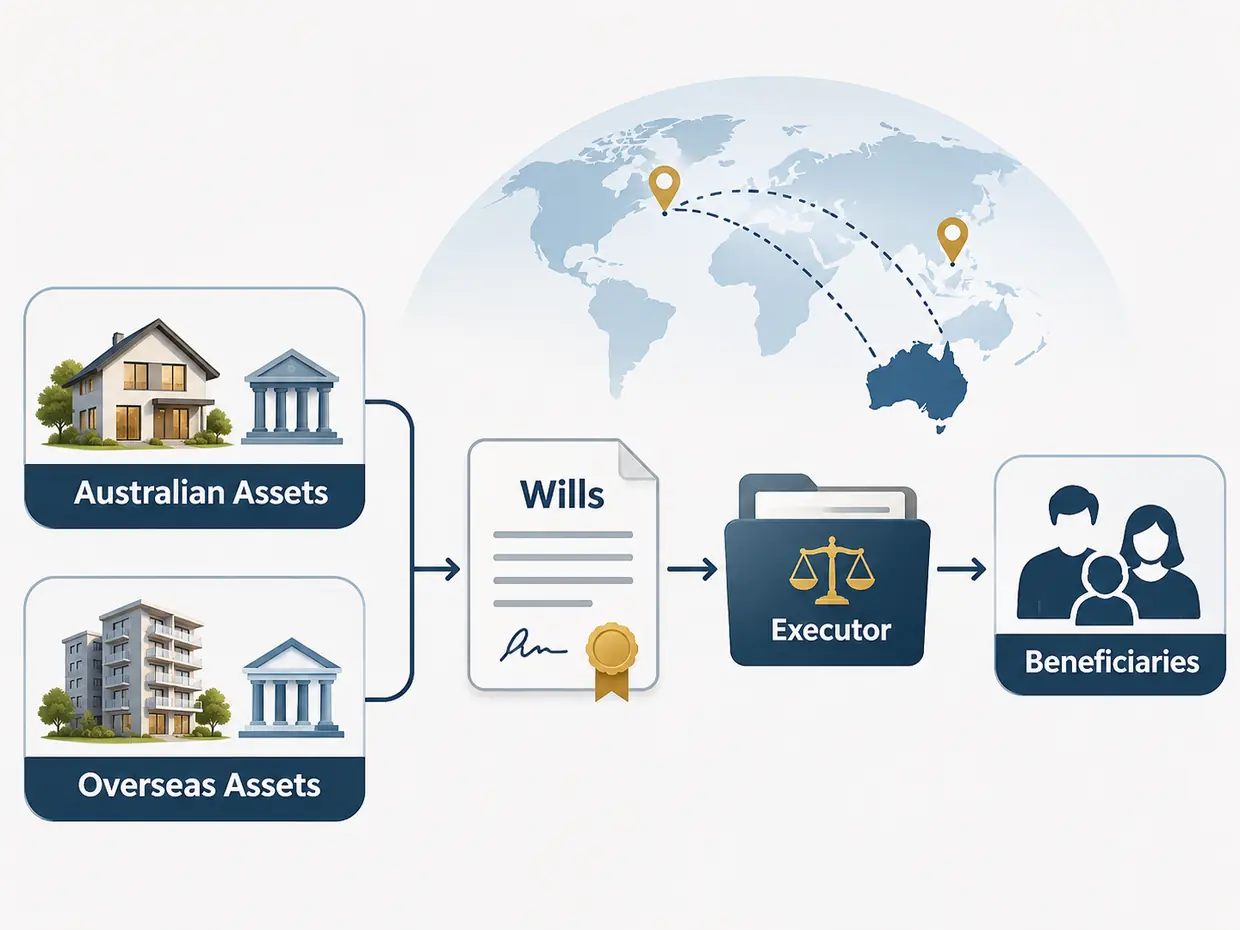
Your executor also needs sufficient information to identify assets, locate documents and understand whom to contact.
This can be particularly important where records are stored overseas or financial institutions require translated, certified or formally authenticated documents.
The exact requirements should be confirmed for the relevant country and institution.
Give Your Executor More Than a Will
Think about what would happen if someone had to administer your estate tomorrow.
Would they know that you owned an overseas account? Could they identify the solicitor who prepared your foreign will? Would they know where the original documents are stored?
A useful estate information file can reduce the need for your family to reconstruct these details.
Consider including:
- An asset register: A current record of properties, financial accounts, investments, business interests and relevant liabilities, organised by country.
- Document locations: Where original wills, property records, trust documents and important agreements can be found.
- Professional contacts: Details of solicitors, accountants, financial advisers and other relevant contacts in each country.
- Beneficiary information: Accurate identifying and contact information for intended beneficiaries.
- Account administration details: Information needed to identify institutions and accounts, without unnecessarily exposing passwords or sensitive credentials.
Keep this information securely stored and separate from documents that require formal legal execution.
Your executor should know how to access it when appropriate, and you should update it whenever your arrangements change.
When Should You Review an International Estate Plan?
Cross-border circumstances can change significantly over time.
Buying an overseas property, moving countries, acquiring citizenship, establishing a business or receiving a foreign inheritance may alter your planning needs.
Family changes matter too. Marriage, divorce, the birth of children or a beneficiary moving overseas can affect how an estate should be structured.
Review your arrangements when a significant change occurs, and periodically even if your circumstances appear stable.
It is also sensible to check whether your Australian and overseas advisers need to coordinate any changes before a new will is signed.
A Clear Plan Today Can Reduce Complications Later
International estate planning is not reserved for people with extensive wealth.
An ordinary family may have a home in Australia, savings overseas, retirement benefits and relatives living in several countries. Those connections can be enough to create legal and administrative questions.
The important step is to recognise those questions while you can still make informed decisions.
Start by identifying your assets, understanding how they are owned and seeking advice about the countries involved. Then make sure your wills, beneficiary arrangements and supporting documents operate as a coordinated plan.
The goal is not to eliminate every possible complication. It is to give your family clear instructions, reliable information and a practical pathway for managing your affairs across borders.
This article provides general information, not personal legal or taxation advice. Estate and inheritance laws differ between Australian states and territories and overseas jurisdictions. Professional advice should be obtained for the specific countries, assets and circumstances involved.
You may also Like

Dispute Resolution in Australia: A Practical Guide for Businesses